
Live Snooker Betting: In-Play Markets, Momentum Reads, and Timing
 Available in US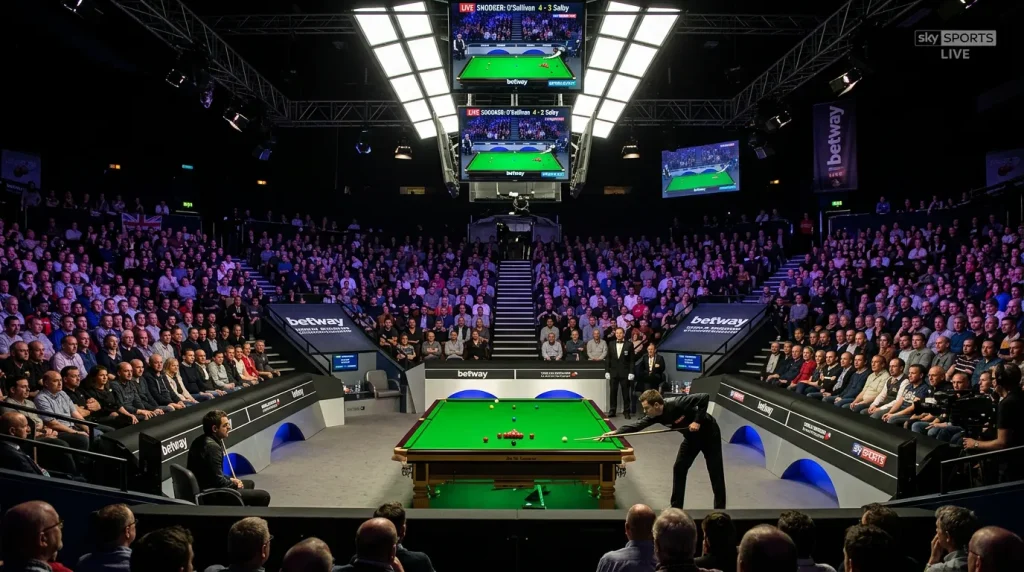
Why Live Betting Transforms Snooker Wagering
The bet that changed my entire approach to snooker wagering was not placed before a match. It was placed during the seventh frame of a World Championship second-round match, with one player trailing 2-4 but playing noticeably better snooker than the scoreline suggested. He had missed two crucial pots in the fifth and sixth frames — uncharacteristic errors from a player whose pot success rate was among the best on tour. The pre-match odds had been right about the favourite, but the in-play odds had overcorrected, pricing the trailing player as though he were collapsing when everything I could see on screen said the opposite. I backed him at 3.40. He won the match 13-9.
Live betting turns snooker from a prediction exercise into a reaction sport. Pre-match, you are working with probabilities derived from historical data and projected performance. In-play, you are watching the data generate itself in real time — every pot, every safety, every missed opportunity tells you something about the state of the match that the pre-match model could not have known. Around 80% of bettors now place their wagers on mobile devices, and the combination of mobile access and live-streamed snooker has made in-play betting the fastest-growing segment of the snooker wagering market.
Snooker is uniquely suited to live betting for a structural reason: the sport is slow. A single frame can last 20 minutes or more, with natural pauses between shots that give you time to assess, calculate, and decide. Compare that to football, where a goal changes the market in seconds, or tennis, where a break of serve reshapes the odds before you can open your betting app. In snooker, you can watch a player compile a break of 40, assess whether he is likely to clear the table, and place a frame-winner bet while he is still potting balls. That tempo is a gift to informed live bettors.
In-Play Markets Available During a Snooker Match
Not every bookmaker offers the same depth of in-play snooker markets, and the availability often depends on whether the match is televised. For a World Championship quarter-final broadcast live on BBC or Eurosport, you can expect to find a comprehensive menu. For a first-round match at a smaller ranking event with no broadcast coverage, the in-play offering may be limited to match winner and next frame winner — if it is available at all.
The core in-play markets break down into four categories. Match winner is the simplest: the odds update continuously based on the frame score and the perceived momentum. Next frame winner is the market I trade most frequently, because it resets after every frame and offers the purest read on current form. Frame correct score — predicting the final frame score of the match from the current position — is a higher-variance market that rewards punters who can project how the remaining frames will play out based on what they have seen. Over/under total frames offers a way to bet on the overall shape of the match without picking a winner.
Beyond these core four, some operators offer highest break in the match, next frame total points, and in rarer cases, next ball potted. The exotic markets tend to carry wider margins and lower liquidity, which means the prices are less efficient but also harder to exploit at meaningful stake levels. I focus the vast majority of my in-play activity on match winner and next frame winner, where the liquidity is deepest and the price movements most responsive to what is actually happening on the table.
One market I have grown to appreciate over the past two seasons is the session winner, available during multi-session matches at the World Championship and occasionally at the Masters. A best-of-25 match played across two sessions creates a natural midpoint where the session-winner market offers a distinct betting proposition. A player leading 5-3 after the first session might be priced at 1.30 to win the second session — but if you have watched his opponent’s body language improve through the final two frames, if the trailing player’s break-building was accelerating while the leader was tightening up, the 3.50 on the session underdog can carry genuine value.
The biggest practical constraint on in-play snooker betting is not the range of available markets but the speed at which you can act. Unlike pre-match betting, where you can deliberate for hours before placing a wager, in-play decisions happen within the natural rhythm of the match. A frame typically lasts between 10 and 25 minutes, and the optimal betting window within that frame — the point where you have enough information to have an edge but the market has not fully adjusted — may only last two or three minutes. Developing the discipline to watch, assess, and act within that window, without rushing into poorly considered wagers, is what makes live snooker betting both more demanding and more rewarding than its pre-match counterpart.
Frame Winner Betting: Reading the Table State
Frame winner is the sharpest in-play market in snooker because it isolates the smallest meaningful unit of competition. A match is a story; a frame is a chapter. And each chapter begins at 0-0 with all 15 reds on the table, offering a fresh read on both players’ current state.
The skill in frame-winner betting is reading the table before the market does. When a player breaks off, watch the first exchange of safeties. Is the player who lost the previous frame coming out aggressively, trying to force an opening? Or has he retreated into a defensive shell, playing safe from distance and avoiding risk? The aggressive response after a loss is almost always the better sign — it indicates a player who is frustrated but engaged, not one who has mentally drifted. The 2024-25 season set a record of 14 maximum breaks, and that record reflects an era of attacking snooker where players are more willing to go for everything when they sense an opening. Reading that intent in real time is what separates frame-winner bettors from frame-winner gamblers.
Table state also matters in a literal, physical sense. Once a frame is underway and the reds are spread, the layout of the remaining balls creates asymmetric scoring opportunities. If the reds are clustered around the pink and black spots, the player at the table has access to high-value colour sequences that could produce a match-altering break. If the reds are scattered across the baulk end of the table with no easy path to a colour, the frame is likely to be scrappy and low-scoring — favouring the better safety player. You do not need to be a professional coach to read these situations; you need to watch enough snooker to recognise the patterns and then check whether the in-play frame-winner price has already adjusted for what you see.
A practical rule I follow: I never bet on the frame winner after the frame has been running for more than ten minutes unless the scoring situation is unambiguous — one player needs snookers, or there are fewer than three reds remaining with a clear points advantage. By that point, the market has usually absorbed enough information to price the frame accurately, and the remaining edge is too thin to justify the stake.
Momentum Analysis: When to Bet and When to Wait
Momentum in snooker is real, but it is not what most punters think it is. The commentators will tell you a player “has the momentum” after winning three frames in a row. What they are describing is a result streak. Genuine momentum — the kind you can bet on — shows up differently: it is visible in shot selection, in the pace of play, in the willingness to attack pots that the player was refusing half an hour ago.
I look for three specific signals before I act on momentum in a live match. First, break size escalation — if a player’s last three scoring visits have gone 35, 52, 78, his confidence and fluency are building. The match-winner odds may not have moved much if the frame score is still close, but the underlying performance trajectory favours that player. Second, first-visit scoring — is the player at the table potting a ball and building a break on his first visit, or is he needing two or three chances before he gets going? Consistent first-visit scoring is the strongest in-play indicator I have found for predicting the next frame winner. Third, body language after a miss — a player who walks back to his seat with purpose after a mistake is processing it and moving on. A player who slumps, stares at the table, or takes an unusually long time to settle is carrying the error into the next frame.
The peak TV audience for the 2025 World Championship final hit 3 million on BBC Two, and matches with that kind of audience pressure add an extra dimension to momentum reads. A player who builds momentum in front of a full Crucible crowd feeds off the atmosphere in a way that further tilts subsequent frames. A player who loses momentum in that environment often spirals faster than he would in a half-empty arena at the International Championship. The venue amplifies what is already happening.
When should you wait rather than bet? Whenever the momentum signal is ambiguous. If a player has won two frames but one was a scrappy re-spotted black and the other was a century clearance, the momentum picture is mixed — the result looks good, but the quality is inconsistent. I also wait during the opening two frames of any session, because players frequently start slowly after a break, regardless of how the previous session ended. The market often carries over the previous session’s narrative into the first frames of the new session, creating a brief window where prices do not reflect the reset that a break provides.
There is one more timing discipline I have built into my process: I set a maximum number of in-play bets per match. For me, that number is three. It does not matter how many opportunities I think I see — after three live bets in a single match, I close the app and watch as a spectator. This cap exists because the longer you watch a match with money at stake, the more emotionally invested you become, and emotional investment degrades the quality of your analysis. Three bets is enough to exploit genuine edges without falling into the trap of overtrading a market that has already absorbed most of the available information.
How Session Breaks Reshape In-Play Odds
Multi-session matches are unique to snooker’s longest formats, and the interval between sessions — typically an overnight break at the World Championship, or a two-hour gap at other events — creates a distinct pricing phenomenon. The match-winner odds at the end of Session 1 reflect everything that happened in those frames: the scoreline, the quality of play, the visible momentum. But Session 2 begins with both players having slept, eaten, practised, and potentially received coaching input that could alter their tactical approach entirely.
The World Championship prize fund of GBP 2,395,000 ensures that every player who reaches the later rounds has enormous financial motivation to reset after a bad session. I have seen players trailing 1-7 after the first session come back to win the match, and I have seen players leading 7-1 collapse in the second session because they played the overnight break passively while their opponent used it to recalibrate. The odds at the start of Session 2 are set by the market, and the market tends to project Session 1’s trajectory forward in a straight line. That linear projection is your opportunity.
My approach to session breaks is simple: I treat the resumption of a multi-session match as a semi-fresh event. I do not ignore the Session 1 scoreline — a four-frame deficit is still a four-frame deficit — but I reassess the players’ likely mental and physical state rather than simply extrapolating from what happened before the break. If the trailing player’s statistical performance in Session 1 was actually better than the scoreline suggests (he lost close frames, he built breaks but failed to convert them), the session-break interval may be all he needs to turn quality into results.
Live Streaming, Data Feeds, and Latency
If you are placing live bets on snooker without watching the match, you are betting blind — and the bookmaker has better sight than you. The odds compilers at major operators have access to real-time data feeds that update frame scores, break information, and occasionally shot-by-shot data within seconds. Your mobile app might show the frame score refreshing every 30 seconds to a minute. That lag is the difference between seeing a player compile a 60 break and knowing the frame is almost decided, versus seeing a frame score that still shows 0-0 because the data feed has not caught up.
Eurosport covered the 2024-25 season with 88 million unique viewers across Europe and 1,500 hours of broadcasting per market. Trojan Paillot, SVP of Sports Rights Acquisitions at WBD Sports Europe, described the extended partnership with WST as a continuation of telling the stories of the sport’s iconic players. For live bettors, the practical value of this broadcasting reach is access: more matches are streamed, more often, across more platforms than at any point in snooker’s history. BBC holds Triple Crown rights through 2032, and WBD signed a new five-year pan-European contract. If you are in Ireland, you can watch most ranking events live through one of these broadcasters or through bookmaker streaming services that require only an active account.
Latency between the broadcast and the betting market varies by platform and by the method of delivery. A satellite TV feed typically runs 3 to 8 seconds behind live. An internet stream adds another 5 to 15 seconds on top of that, depending on your connection and the platform’s encoding pipeline. The bookmaker’s data feed, by contrast, may be only 1 to 2 seconds behind live. This means the bookmaker’s odds can react to a missed pot before you have seen it on your screen. The practical implication is straightforward: if you are relying on a streaming feed to inform your live bets, you should place your bets based on what you expect to happen next rather than reacting to what just happened. By the time you see the miss and try to back the opponent, the price has already moved.
For Irish punters, the best setup I have found for live snooker betting combines a television broadcast — BBC or Eurosport, depending on the tournament — with a separate device for placing bets. Watching on one screen and betting on another eliminates the temptation to tab between a stream and a betting slip on the same phone, which inevitably costs you seconds of attention in both directions. The television feed is higher quality, lower latency, and carries expert commentary that occasionally highlights tactical shifts before they become obvious from the raw visuals. If you are serious about in-play snooker, invest in the viewing setup before you invest in the bets themselves.
The Cash-Out Button in Live Betting
Cash-out is the most psychologically dangerous feature in live snooker betting. It sits there on your screen, showing you a green number that represents guaranteed profit, and every instinct in your body screams to press it. But cash-out is not an exit — it is a bet. When you accept a cash-out offer, you are effectively placing a new bet that the outcome from this point forward will go against your original position. The bookmaker prices the cash-out offer with a margin in their favour, which means you are consistently leaving money on the table every time you use it.
That said, there are moments when cashing out is the correct play. If new information has emerged since you placed your bet — an injury during the interval, a visible change in a player’s demeanour or shot quality, a tactical shift you did not anticipate — the cash-out locks in profit on a bet whose edge may have evaporated. The key is making the decision based on updated analysis, not on anxiety. If your original thesis still holds and the match is unfolding roughly as you expected, taking a reduced profit because you are nervous about the final frames is leaving expected value on the table.
I cover the mathematics of cash-out decisions, including partial cash-out mechanics and the hidden margin bookmakers embed in their offers, in a separate guide on snooker betting cash-out strategy. For the purposes of live betting, the rule I follow is simple: I only cash out when the in-play evidence contradicts my pre-match analysis, never when it merely makes me uncomfortable.
Live Snooker Betting: Your Questions Answered
Which in-play markets are available during a snooker match?
The core markets are match winner, next frame winner, frame correct score, and over/under total frames. Televised matches at major events typically offer all four plus extras like highest break and session winner. Non-televised matches at smaller ranking events may only offer match winner and next frame winner, with some operators suspending in-play markets entirely if no broadcast feed is available.
How does session scheduling affect live snooker odds?
Session breaks — particularly overnight intervals at the World Championship — reset the playing conditions in ways the market often underestimates. The odds at the start of a new session typically carry forward the momentum narrative from the previous session, but players can recalibrate their approach during the break. This creates value opportunities at the resumption, especially when a trailing player"s statistical performance in the previous session was better than the scoreline suggests.
What is the typical streaming delay for live snooker betting?
Satellite TV feeds run approximately 3 to 8 seconds behind live action. Internet streams add another 5 to 15 seconds of latency depending on the platform and your connection. Bookmakers" internal data feeds operate with only 1 to 2 seconds of delay. This means odds can shift before you see the event on screen. Successful live bettors anticipate rather than react, placing bets based on developing patterns rather than individual shots.
Articles
Published by the World Snooker Betting team.
