
Crucible Theatre and Snooker Odds: How the Venue Shapes Betting History
 Available in US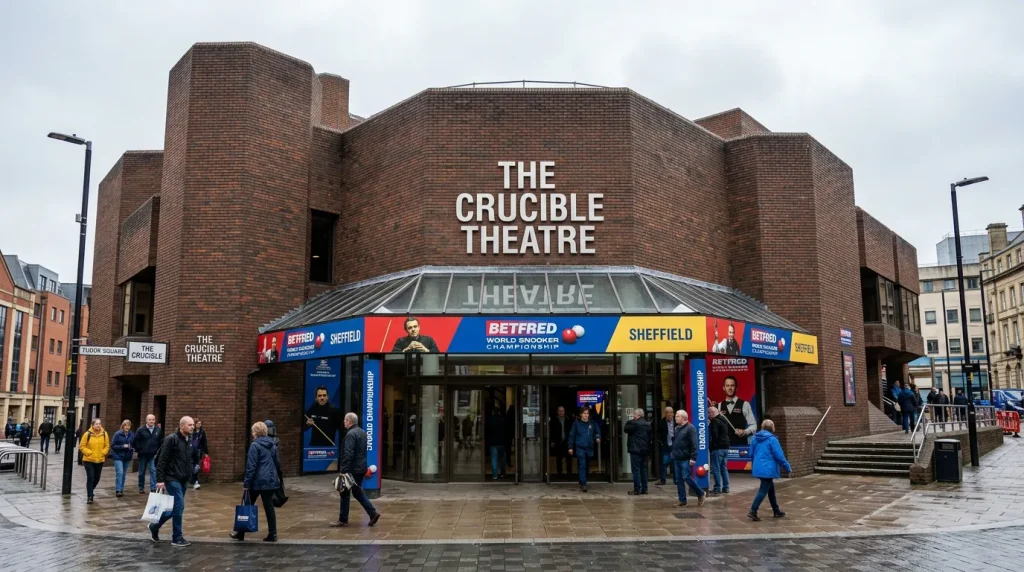
Why One Theatre in Sheffield Moves Global Snooker Odds
There’s a theatre in Sheffield that seats 980 people, has no air conditioning worth mentioning, and routinely influences how bookmakers across three continents set their prices. I’ve been to the Crucible four times, and the atmosphere inside that room is unlike anything else in sport. The audience sits close enough to hear the cue ball spin. The players’ breathing is audible during safety exchanges. Every missed pot echoes. That intensity isn’t just theatre – it’s a variable that moves odds.
The World Championship has been held at the Crucible since 1977, and the venue’s characteristics have become embedded in how bookmakers model the tournament. A player’s Crucible record – not just their general ranking – is a pricing factor. Some bookmakers explicitly adjust their World Championship odds based on previous Crucible performances, treating the venue as a separate skill dimension alongside break-building and matchplay. The prize fund of £2,395,000 draws every serious player, but the Crucible itself filters them in ways that matter for betting.
The Crucible Curse: Statistical Reality or Myth
The Crucible Curse – the observation that no first-time World Champion has successfully defended the title at the Crucible on their next attempt – is one of snooker’s most discussed patterns, and bookmakers price it as if it’s real.
The statistical evidence is genuine but needs context. The curse has held for decades, spanning different eras and playing styles. First-time champions consistently return to Sheffield the following year as bookmaker favourites or near-favourites, and consistently fail to retain the title. The pattern is robust enough that markets have priced it into defending champion odds for at least the last fifteen years.
But is it the venue causing the pattern, or something else? The most plausible explanation isn’t mystical – it’s motivational and scheduling. A player who wins the World Championship for the first time experiences a life-changing event: prize money, media demands, exhibition bookings, and the psychological shift from hunter to hunted. The following season’s schedule is busier, the expectations heavier, and the return to the Crucible carries pressure that didn’t exist the first time. The peak TV audience for the 2025 final was 3 million viewers on BBC Two with a 22.5% audience share – the kind of exposure that transforms a player’s public profile overnight and makes the following year’s defence an entirely different psychological proposition.
For betting purposes, the curse is useful not because it’s supernatural but because it quantifies a real psychological pattern. I consistently lay defending champions at their post-victory prices, which tend to be shorter than their true probability justifies. The market over-weights the prestige of the current champion and under-weights the historical evidence that defending is harder than winning. Barry Hearn himself has acknowledged the tension between the Crucible’s legacy and the sport’s commercial needs, noting bluntly that the relationship between the event and Sheffield must be reciprocal. That uncertainty about the venue’s future adds another dimension – players who might be making their last Crucible appearance carry emotional weight that’s hard to quantify but real in its effect on performance.
How Venue Pressure Affects First-Time Finalists
The first time a player walks into the Crucible for a World Championship match, the venue shrinks. The practice room is cramped, the walk to the arena is short and claustrophobic, and the single-table setup in the later rounds means every shot is watched by everyone in the room and millions on television. The total BBC TV reach for the 2025 World Championship was 12.6 million viewers. For a player accustomed to playing in front of a few hundred spectators at a ranking event, that visibility is genuinely disorienting.
First-time finalists at the Crucible have a poor record, and this is reflected in the odds – but often not enough. Bookmakers adjust prices for Crucible inexperience, but they tend to apply a generic discount rather than assessing the specific player’s temperament under pressure. A first-time finalist who reached the final through a series of decisive, dominant victories is a different proposition from one who scraped through multiple deciding frames. The latter is more likely to have depleted emotional reserves, and the final – best-of-35 over two days – demands sustained concentration that rewards freshness.
I’ve tracked first-time finalists’ frame-by-frame performance over the last eight World Championship finals and found a consistent pattern: they tend to start well (the adrenaline of the occasion carries them through the opening session), dip in the middle sessions (fatigue and pressure compound), and either collapse or rally in the final session depending on the deficit. This pattern creates in-play betting opportunities – backing the experienced finalist during the middle sessions when the first-timer’s early advantage is evaporating often provides value because the live odds haven’t fully adjusted for the pattern.
Will the World Championship Leave the Crucible
The question of whether the World Championship will relocate from Sheffield is not hypothetical – it’s been publicly discussed by the sport’s most senior figures and it has direct implications for how future World Championship odds should be modelled.
A potential relocation to a larger venue – possibly in the Middle East or Asia, where the sport’s audience is growing fastest – would fundamentally alter the betting landscape. The Crucible’s intimate setting, its specific table conditions, and its atmospheric pressure are all priced into current models. A new venue would reset decades of venue-specific data. Every player would be a “first-timer” at the new location, eliminating the Crucible-specific edges that experienced bettors have built into their analysis.
The potential record seasonal prize fund of £19 million for the 2024-25 WST season, representing 35% growth, signals the commercial ambitions driving these discussions. Saudi Arabia’s 10-year Snooker Masters deal demonstrates that the sport is actively courting international investment. If the World Championship moves, the transition period – the first two or three years at a new venue – would create unusual pricing opportunities because bookmakers would be modelling without historical venue data for the first time since 1977.
My planning assumption: the Crucible retains the World Championship through at least 2027 based on BBC’s broadcasting agreement, but beyond that, all bets – literally – are off. I continue to build Crucible-specific models for current seasons while keeping one eye on the commercial signals that might render those models obsolete.
What is the Crucible Curse in snooker?
The Crucible Curse refers to the historical pattern where no first-time World Snooker Champion has successfully defended the title at the Crucible Theatre on their next attempt. The pattern spans decades and is attributed to increased pressure, busier schedules, and the psychological shift from challenger to defending champion. Bookmakers price this pattern into their odds, typically offering shorter prices on defending champions than the historical data supports.
Has a first-time Crucible qualifier ever won the World Championship?
Qualifiers have reached the final and caused significant upsets at the Crucible, though winning the entire tournament from qualifying remains exceptionally rare. The venue"s intense atmosphere and the demanding 17-day schedule create compounding pressure that typically favours experienced Crucible campaigners. For betting purposes, backing qualifiers in early rounds can offer value, but outright qualifier bets carry extremely high variance.
Articles
Created by the "World Snooker Betting" editorial team.
